Walk around any subdivision cut in New Plymouth and you will see the story in the face of the excavation. A thin cap of volcanic ash overlying soft, weathered sandstone that turns to paste after a week of rain. That transition zone catches a lot of designers off guard. The team here has reviewed site investigation data from Bell Block to Omata, and the pattern repeats: strength drops sharply at the residual soil interface, and standard bearing assumptions collapse with it. A properly scoped soil mechanics study does not just classify the material, it maps where the weak horizon sits relative to the foundation level. When the planned cut exposes that layer, we bring in slope stability analysis to check whether a temporary batter will stand up through winter or whether shoring becomes mandatory before the first pour.
In New Plymouth the difference between a textbook soil profile and what the borehole actually returns is a weathered seam that can halve the bearing capacity in less than a metre of depth.
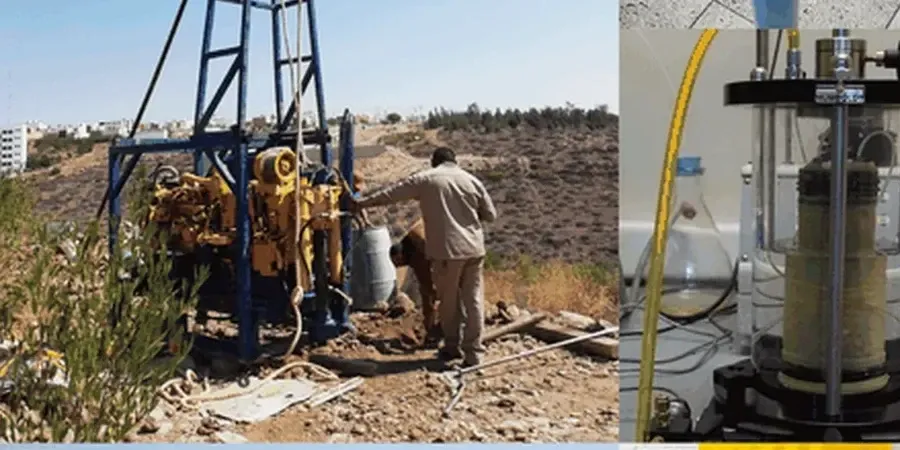
Approach and scope
Local geotechnical context
Sitting at roughly 39 degrees south, New Plymouth receives over 1,400 millimetres of rain annually, spread across 140-odd wet days. That persistent moisture drives pore pressure into the near-surface ash and colluvium, and time after time we see retaining structures designed on summer shear strength fail to hold once the ground saturates. Rainfall is not an afterthought here, it is a loading condition. A soil mechanics study that uses drained parameters from a dry-season borehole can understate the risk by a wide margin. Our lab runs saturated triaxial tests and consolidates samples to match in-situ stress before shearing, because the effective stress path in a Taranaki winter is nothing like what a textbook drained envelope suggests. On sites within a few hundred metres of the coast, groundwater salinity also influences clay mineral behaviour, so we pair the atterberg limits with pore fluid chemistry checks when the client's design life exceeds fifty years.
Reference standards
NZS 4402:1986 – Methods of testing soils for civil engineering purposes, NZS 1170.5:2004 – Structural design actions – Earthquake actions, NZGS Guideline for the Field Classification of Soil and Rock (2005), AS 1289 series – referenced where NZS 4402 methods align
Related technical services
Residential and Light Commercial Soil Mechanics Package
Covers single dwellings, townhouse blocks, and low-rise commercial buildings up to three storeys. Includes machine-dug test pits with logged profiles, pocket penetrometer and hand vane profiles, laboratory classification to the NZGS field guide, Atterberg limits on cohesive layers, and a bearing capacity and settlement statement referenced to NZS 3604 or AS/NZS 1170 as appropriate. Turnaround typically six to eight working days from site completion.
Detailed Geotechnical Investigation with Advanced Laboratory Testing
For multi-storey structures, retaining walls over 1.5 metres retained height, and sites within the coastal hazard zone. Adds CPT or SPT boreholes, undisturbed Shelby tube sampling, consolidated-undrained triaxial testing, one-dimensional consolidation, and chemical aggressivity profiling. The deliverable includes a full geotechnical interpretative report with foundation options, liquefaction screening, and earth pressure parameters ready for structural modelling.
Typical parameters
Questions and answers
What does a soil mechanics study cost for a standard residential section in New Plymouth?
For a typical single-dwelling site on a suburban section, the soil mechanics study ranges from NZ$4,580 to NZ$8,810 depending on access, the number of test pits or boreholes required, and the laboratory testing programme. Sites with difficult access, steep slopes, or known fill will push toward the upper end because they demand more investigation points and additional stability checks.
How deep do you investigate for a soil mechanics study, and does it vary across New Plymouth?
Depth depends on the foundation type and the soil profile encountered. For a standard slab-on-grade under NZS 3604, we typically probe to 2.0 to 3.0 metres below ground level. Where deep piles or basement excavations are planned, boreholes reach 15 to 25 metres, particularly in the CBD where the Manganui Formation can extend well beyond that. The investigation depth is always confirmed against the pressure bulb of the proposed foundation to ensure the zone of influence is fully captured.
Do you test for liquefaction as part of the soil mechanics study?
Yes. New Plymouth sits in a moderate seismic zone, and the interbedded silts and sands beneath the coastal terraces can be susceptible. We apply the NZGS Module 4 screening framework, using SPT blow counts or CPT tip resistance data to calculate the factor of safety against liquefaction for the design earthquake. Where the risk is non-negligible, the report quantifies expected settlement and lateral spread potential so the structural engineer can decide whether Improvement or a stiffer foundation system is warranted.