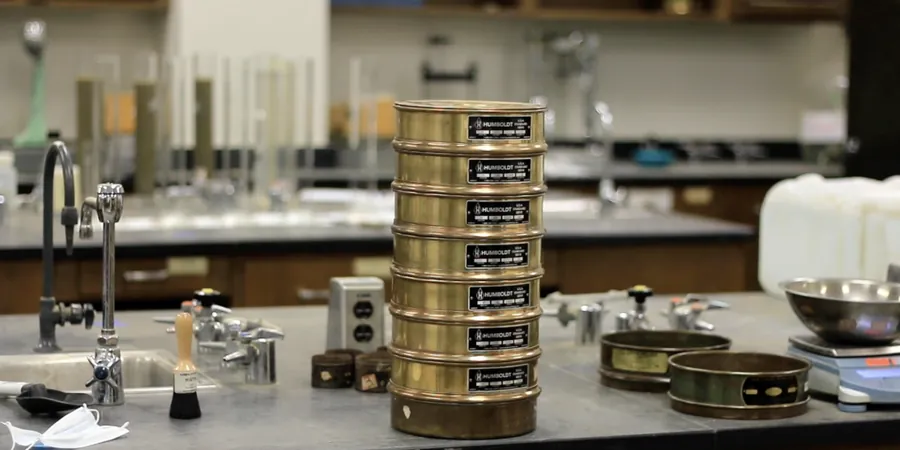
A full grain size distribution for New Plymouth ground conditions starts with the stack of brass sieves on a Ro-Tap shaker, but the critical part happens after the wash — when the minus 75-micron fraction settles inside a 1000 ml glass cylinder under controlled temperature. We run the hydrometer test in a 20 °C water bath, recording readings at 2, 5, 15, 30, 60, 240 and 1440 minutes per NZS 4402. The city sits on a mix of lahar-derived volcaniclastics, weathered sandstone from the Matemateaonga Formation, and coastal dune sands near Ngāmotu Beach. That spread of parent materials makes it nearly impossible to classify a soil from a single visual inspection. A combined sieve-plus-hydrometer curve gives the engineer the full picture — from gravel down to colloidal clay — and that matters when you are designing cut-to-fill transitions on a sloping section in Merrilands or Westown. For projects where the fines content is borderline, we often pair the hydrometer run with Atterberg limits to confirm whether the material behaves as silt or clay under New Plymouth's high-rainfall moisture regime.
A single hydrometer curve can distinguish between a free-draining sand and a moisture-sensitive silt — a difference that determines whether a New Plymouth foundation needs subsoil drainage or not.
Approach and scope
Local geotechnical context
NZS 3404:2010 — New Zealand's earthworks standard — ties fill classification directly to the particle-size distribution, and in New Plymouth the penalty for misclassification is concentrated on silty lahar clays that look competent in summer but lose strength sharply after a wet winter. A soil placed as engineered fill with more than 40 percent fines will behave very differently from one with 15 percent, even if both are called 'sandy clay' in the borehole log. The hydrometer step is not optional when the wash-through on the 75 µm sieve exceeds 12 percent; skipping it leaves the entire fines tail undefined, which means the contractor is guessing at compaction moisture and the designer has no reliable estimate of permeability. For sites near the Huatoki Stream or other watercourses, the grain-size curve also feeds directly into scour assessment and filter-compatibility checks for retaining walls with drainage stone backfill, where a mismatch between soil and filter gradation can clog the drain within a single rainy season.
Reference standards
NZS 4402/D6913M-17: Standard Test Methods for Particle-Size Distribution (Gradation) of Soils Using Sieve Analysis, NZS 4402: Standard Test Method for Particle-Size Distribution (Gradation) of Fine-Grained Soils Using the Sedimentation (Hydrometer) Analysis, NZS 3404:2010 — New Zealand Earthworks Standard (fill classification tables), NZGS Guideline: New Zealand Geotechnical Society Soil Classification — field description to symbol mapping
Related technical services
Combined Sieve & Hydrometer (Full PSD)
Full gradation from gravel to clay fraction, reported as percent passing by dry mass with Cu and Cc coefficients. Includes oven-dry moisture content, wash-through mass, and hydrometer sedimentation curve on NZGS-compliant semi-log plots.
Wash Sieve Only (Coarse Fraction)
Sieve analysis from 75 mm to 75 µm with wash-through determination. Suitable for clean sands and gravels where fines are visually low. Provides D10–D60 for permeability estimation and filter design.
Hydrometer-Only Run (Fines Fraction)
Sedimentation analysis on the minus 2 mm fraction when the coarse component is already known or not required. Reports silt and clay percentages separately, with a 24-hour extended reading set for clay-rich soils.
Typical parameters
Questions and answers
How much does a full grain size analysis (sieve + hydrometer) cost in New Plymouth?
For a combined sieve and hydrometer test following NZS 4402/D7928, budget between NZ$200 and NZ$280 per sample. The exact figure depends on the number of samples in the batch and whether we need to run an extended 24-hour hydrometer reading for high-clay soils. Turnaround is typically five working days from sample receipt.
Which New Plymouth soil types need the hydrometer step?
Any soil where the wash-through on the 75 µm sieve exceeds 12 percent of the dry mass should proceed to hydrometer analysis. In practice, most lahar-derived silts and weathered volcanic clays across the city trigger this threshold. Clean dune sands near the coast often fall below it, so a wash sieve alone may be sufficient.
How do you take a representative sample for grain size testing?
We follow NZS 4402 for aggregate sampling and NZGS guidelines for fine-grained soils. For disturbed samples, we need a minimum of 500 g of air-dried material passing the 4.75 mm sieve for the hydrometer portion. The sample should be sealed in a plastic bag immediately after extraction to prevent moisture loss — especially important in New Plymouth's humid coastal air.
What do the uniformity coefficient (Cu) and curvature coefficient (Cc) tell me?
Cu describes the spread of particle sizes — values below 4 indicate a uniformly graded soil, above 10 suggest a well-graded mix. Cc captures the shape of the gradation curve between D10 and D60. Together they determine whether a granular soil meets filter criteria or is suitable as select fill under NZS 3404. The coefficients are calculated automatically from the combined sieve-plus-hydrometer curve.