One of the costliest mistakes we see in New Plymouth is a project team pressing ahead with isolated pad footings on ground that simply cannot handle differential settlement. The Mount Taranaki volcanic apron has deposited layers of ash, lahar debris, and soft alluvium that change dramatically over short distances, and when you add the marine clays near the coast, a standard footing solution turns into a long-term liability. A properly designed mat foundation distributes structural loads across a much larger footprint, reducing bearing pressure and bridging localised soft spots that would otherwise cause angular distortion in the superstructure. Our team works with the NZGS guidelines and NZS 3404 to size the raft, stiffening beams, and reinforcement layout based on actual stratigraphy, not generic assumptions. For a city where the wind-driven rain from the Tasman Sea saturates the near-surface soils for months at a time, ignoring this step is simply bad business.
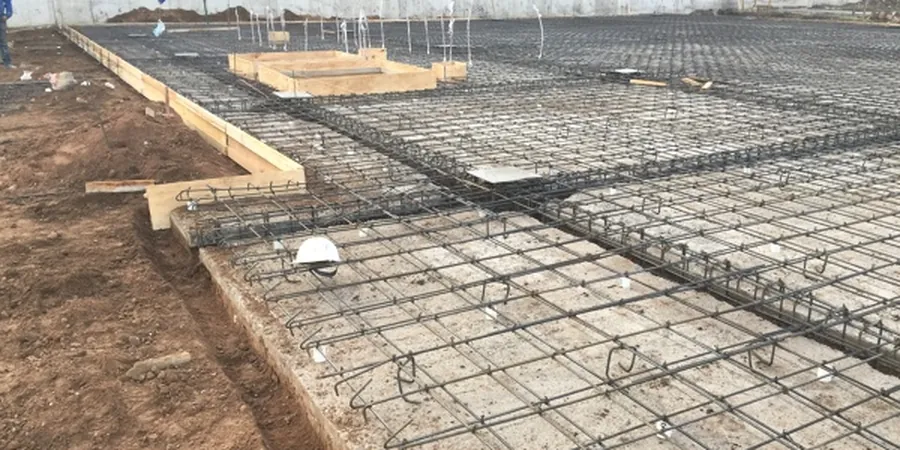
A well-designed raft foundation turns a problematic site into a straightforward build — the key is knowing the soil profile before the structural model is even started.
Approach and scope
- Three-dimensional soil-structure interaction modelling using plate elements on Winkler springs, calibrated to site-specific modulus of subgrade reaction values derived from In-Situ.
- Punching shear verification around columns and lift cores under ultimate limit state loads, particularly critical for irregular column grids common in New Plymouth's mixed-use developments.
- Construction joint detailing and pour sequencing plans that account for the city's maritime climate, where sudden rain squalls can compromise large-area concrete placement.
- Integration of Improvement — rigid inclusions or vibrocompaction — when the natural bearing capacity falls below the raft's design pressure.
Local geotechnical context
New Plymouth's exposure to both long-period earthquake shaking from the Hikurangi subduction zone and the shallow volcanic earthquakes near the mountain creates a dual seismic demand that poorly designed foundations cannot handle. The coastal strip from Port Taranaki to Bell Block sits on soft sediments that amplify ground motion, and a raft foundation that is not detailed for the resulting inertial forces can suffer edge curling, excessive settlement, or even structural disconnection at construction joints. Moisture variation is another enemy: the region's high rainfall — averaging over 1,400 millimetres annually — causes expansive behaviour in the volcanic ash soils, leading to seasonal heave and shrinkage cycles. Our designs incorporate underslab drainage, capillary breaks, and reinforcement layouts that resist the resulting bending moments. In areas mapped as liquefaction-prone by the regional council, the raft is integrated with ground densification or stone columns to maintain post-event bearing capacity, ensuring the foundation remains functional when it is needed most.
Reference standards
NZS 3404:1997 – Steel Structures Standard, NZS 3101:2006 – Concrete Structures Standard, NZS 1170.5:2004 – Structural Design Actions – Earthquake Actions, NZS 3604:2011 – Timber-framed buildings (for residential compatibility), NZGS Guidelines for Earthquake Geotechnical Engineering, MBIE Guidance on Foundation Design in Volcanic Soils
Related technical services
Full Raft & Mat Foundation Engineering Design
Complete structural design package including finite element analysis, reinforcement detailing, construction joint layout, and staged pour specifications. We produce drawings and calculation reports suitable for building consent submission to the New Plymouth District Council, with explicit references to NZS 3404 and NZS 3101 compliance paths.
Geotechnical-Structural Interface Coordination
Technical coordination between the site investigation team and the structural designer. We review CPT and borehole logs, establish design soil parameters jointly with the geotechnical engineer, and ensure the foundation design responds to the actual stratigraphy — not just the worst-case assumption. This service is particularly valuable on New Plymouth sites where ground conditions change significantly within the building footprint.
Typical parameters
Questions and answers
How much does raft foundation design typically cost for a New Plymouth project?
For a standard commercial or light industrial building in the New Plymouth area, the engineering design fee for a raft or mat foundation typically ranges from NZ$1,680 to NZ$5,990 depending on the building footprint, number of load cases, and complexity of the soil profile. A straightforward single-storey warehouse on competent ground sits at the lower end, while a multi-storey structure with irregular column grids and challenging volcanic soils will require more detailed modelling and falls toward the upper end. We carry out a fixed-price proposal after reviewing the preliminary architectural layout and the geotechnical investigation report.
What is the difference between a raft foundation and a conventional footing system?
A raft foundation is a continuous reinforced concrete slab that covers the entire building footprint and supports all columns and walls as a single integrated unit, whereas conventional isolated or strip footings support individual columns or wall lines separately. The raft distributes structural loads over a much larger area, which reduces bearing pressure on the soil and helps bridge localised soft or compressible zones. This makes rafts particularly suitable for New Plymouth's variable ground conditions, where volcanic ash layers and coastal sediments can cause uneven settlement if footings are not connected.
Can a raft foundation be used on liquefaction-prone sites in New Plymouth?
Yes, but it requires careful integration with Improvement measures. The raft itself provides structural rigidity that helps the building move as a single unit during ground shaking, but it does not prevent the underlying soil from liquefying. For sites in New Plymouth mapped as having moderate to high liquefaction potential — common in the Bell Block and coastal areas — we typically combine the raft design with stone columns, vibrocompaction, or rigid inclusions to densify the susceptible layers. The raft is then designed to span between the improved zones and maintain post-earthquake functionality.
What information do you need to start the raft foundation design?
We need a geotechnical investigation report with CPT or SPT data down to at least the depth where stress increase from the foundation becomes negligible — typically 1.5 to 2 times the raft width. We also require the architectural and structural layout showing column positions, estimated loads, lift pits, and any basement or retaining elements. For New Plymouth projects, we additionally request any New Plymouth District Council hazard overlays for the site, particularly those related to flooding, coastal erosion, or volcanic lahar paths, as these can influence the finished floor level and the drainage strategy beneath the raft.