New Plymouth sits on the Taranaki ring plain, not far from the active Mt Taranaki volcanic cone, and the city’s subsurface tells a complex story of volcanic lahar deposits, coastal sands, and alluvial silts. The 2018 MBIE guidance on earthquake geotechnical engineering changed how we approach CPT test screening here, especially where loose pumice-rich layers and shallow groundwater combine. A soil liquefaction analysis is not a generic checkbox. In New Plymouth, it means correlating cone tip resistance with fines content from grain size profiles to pick up the subtle volcanic grain crushability that standard curves can miss. The New Plymouth District Council requires a site-specific assessment for any major structure where the water table is within 5 m of the surface, and our lab runs the full triggering-to-consequence workflow under NZGS Module 4 and 5. We combine downhole shear wave velocity data with MASW surface arrays to build a solid Vs profile, then feed it into the liquefaction resistance calculation. For builders along the Huatoki Stream corridor or near the port, getting this right early avoids expensive Improvement surprises later.
Liquefaction in New Plymouth is not just about clean sand: volcanic pumice grains crush and drain differently, demanding a lab-validated assessment.
Approach and scope
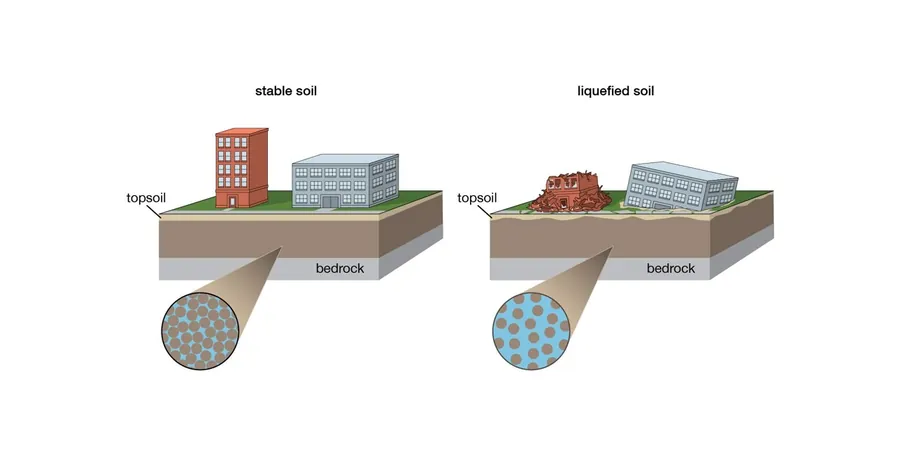
Local geotechnical context
A five-storey apartment project on fill over estuarine sediments near the Waiwhakaiho River mouth showed us how quickly liquefaction risk can be underestimated. The initial desktop screening flagged the site as marginal, but our CPT probes hit a 2.8 m thick loose pumiceous sand layer at 4 m depth, directly below the groundwater table. Standard SPT blowcounts were in the 6–9 range, and fines content from wash sieving came back at 12% non-plastic. The triggering analysis gave factors of safety below 0.8 for a 500-year return period event, with LPI values exceeding 15 across the central part of the site. That triggered a requirement for Improvement: the structural engineer and geotechnical contractor evaluated stone columns as a densification solution to raise the CPT tip resistance above the triggering threshold. Without the detailed liquefaction analysis, the building could have been founded on a layer that would lose strength during a Mw 6.5 Cape Egmont event, leading to differential settlement of 100 mm or more. In New Plymouth, ignoring volcanic soil behavior in a liquefaction study is the single costliest shortcut a developer can take.
Reference standards
NZS 1170.5:2004 (seismic actions – New Plymouth zone factor), NZGS/MBIE Module 4: Earthquake geotechnical engineering (liquefaction assessment), NZGS/MBIE Module 5: Improvement of soils prone to liquefaction, NZS 4402 (CPT electronic friction cone and piezocone), NZS 4402.6.5.1:1988 (determination of liquid limit, plastic limit, and plasticity index), Boulanger & Idriss (2014) CPT and SPT liquefaction triggering procedures
Related technical services
CPT-based liquefaction triggering
We push a seismic piezocone at your New Plymouth site, recording tip resistance, sleeve friction, and pore pressure at 20 mm intervals. The data feeds into the Boulanger & Idriss (2014) CPT procedure with Taranaki-specific magnitude scaling, producing factor of safety profiles and LPI contour maps.
SPT-based assessment with energy correction
For sites where CPT access is limited, we run SPT borings with calibrated automatic trip hammers and record energy efficiency per NZS 4402. Corrected N1(60) values are processed through the Youd et al. (2001) and Idriss & Boulanger (2008) framework, with fines content verified in our lab.
Cyclic triaxial liquefaction testing
We reconstitute undisturbed or remolded specimens from your site and run undrained cyclic triaxial tests at multiple cyclic stress ratios. The result is a site-specific cyclic resistance curve that replaces generic correlations, particularly useful for volcanic sands that fall outside standard CPT charts.
Liquefaction consequence and settlement report
Beyond triggering, we compute post-liquefaction volumetric strain and reconsolidation settlement using the Zhang et al. (2002) method, calibrated to New Plymouth soil types. The report includes differential settlement estimates and lateral spreading displacement where sloping ground or a free face is present.
Typical parameters
Questions and answers
What does a soil liquefaction analysis cost for a typical New Plymouth residential section?
For a standard residential section in New Plymouth, a full liquefaction assessment including CPT testing, lab fines content verification, and an NZGS Module 4 triggering report typically runs between NZ$4,730 and NZ$7,030, depending on the number of cone soundings and whether cyclic triaxial validation is required.
Is liquefaction assessment mandatory for all new builds in New Plymouth?
The New Plymouth District Council requires a site-specific liquefaction assessment for any building classified as Importance Level 2 or higher where the groundwater table is within 5 m of the proposed foundation level and the site is underlain by sands or silty sands. Your structural engineer will confirm the requirement during the building consent process.
How long does a liquefaction analysis take from site investigation to final report?
Fieldwork with CPT or SPT rig typically takes one to two days in New Plymouth. Lab testing for grain size and Atterberg limits adds three to five working days, and the engineering report is delivered within seven to ten working days from the last field day, assuming no cyclic triaxial testing. Cyclic triaxial adds approximately two weeks.
What is the difference between LPI and LSN in a New Plymouth context?
LPI (Liquefaction Potential Index) integrates the factor of safety and thickness of liquefiable layers over the full depth profile, giving a single number for a site. LSN (Liquefaction Severity Number) is a New Zealand-specific index from NZGS Module 5 that weights shallow layers more heavily and correlates better with observed land damage. We report both where the council requests it.