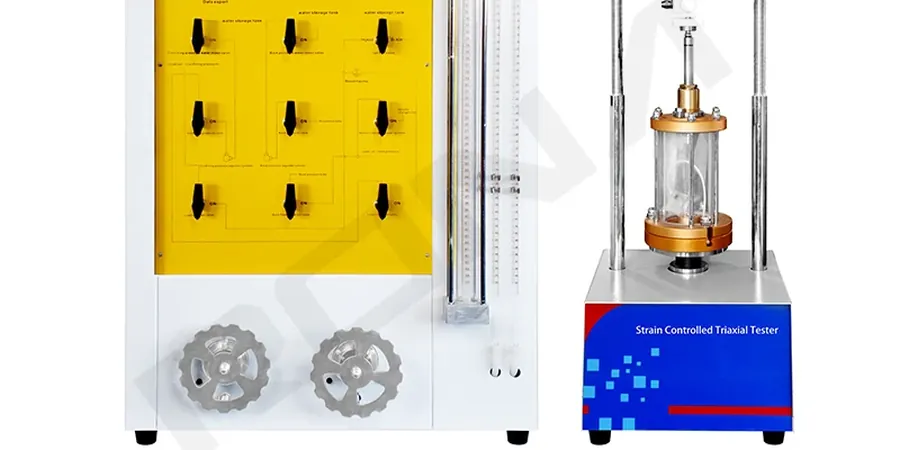
New Plymouth’s expansion down the Waiwhakaiho River terraces and up toward the Pouakai Range has pushed building platforms into some properly variable ground. The 2016 Kaikōura earthquake sequence, felt here as a long-period motion, reminded everyone that Taranaki’s seismic hazard isn’t theoretical. A standard site investigation gives you bearing capacity, but when you need to know how the soil actually behaves under load—drained or undrained, at the in-situ confining pressure—the triaxial test becomes the reference point. We run these tests in our ISO 17025-accredited lab, following NZGS guidelines and NZS 4402:1986 methods, and we correlate results with field data from CPT testing to build a ground model that holds up under peer review. For deep excavations near the CBD or retaining structures along the coastal strip, the triaxial test is what turns a guess into an engineered parameter.
Effective cohesion and friction angle from a properly consolidated triaxial test can reduce foundation costs by 15–20% compared to conservative presumptive values.
Approach and scope
Local geotechnical context
Taranaki’s volcaniclastic soils contain halloysite and allophane—minerals that produce unusually high natural water contents and can collapse under load if not properly identified. A standard penetration test won’t catch that; the triaxial test will. We regularly see effective friction angles in the 28–34° range for residual andesitic silts, but the undrained shear strength can drop below 30 kPa when the confining stress exceeds the preconsolidation pressure. That’s the failure mechanism behind several retaining wall issues we’ve investigated in the Strandon area. If your site sits within the 1:500-year flood zone of the Huatoki Stream or on fill over former swamp deposits, the triaxial test should be non-negotiable in your ground investigation scope. The difference between a CU test with pore pressure measurement and a quick UU screening is the difference between a wall that lasts 50 years and one that tilts in the first wet winter.
Service video
Reference standards
NZS 4402:1986 Test 6.2 – Triaxial compression (CU, CD), NZS 4402 – Consolidated Undrained Triaxial Compression Test, NZS 3404:1997 – Steel Structures (seismic demand & foundation design), NZGS Soil & Rock Description Guidelines (2005)
Related technical services
Multi-stage CU triaxial on a single specimen
When undisturbed sample recovery is limited—common in the pumice-rich layers under New Plymouth—we run a multi-stage consolidated-undrained test on one specimen. Three confining stress stages with shearing stopped just after peak, then reconsolidated, give a full Mohr-Coulomb envelope from one tube sample. Saves drilling cost and still meets NZGS requirements for slope and foundation design.
Stress-path triaxial with local strain measurement
For deep excavations or basement construction in the CBD where wall deflection limits are tight, we instrument the specimen with on-sample LVDTs and follow a prescribed stress path that mimics the unloading sequence behind a propped wall. Pore pressure response, axial strain, and volumetric strain are logged at 0.1-second intervals. The output feeds directly into Plaxis or FLAC parameter calibration.
Typical parameters
Questions and answers
What does a triaxial test cost for a project in New Plymouth?
Triaxial testing in New Plymouth typically runs between NZ$3,140 and NZ$5,120, depending on the test type, specimen diameter, and whether you need a single-stage or multi-stage programme. A basic UU test on a 38 mm specimen sits at the lower end; a full CD test with local strain instrumentation on a 100 mm specimen, including back-pressure saturation and B-check, will be at the upper end. We recommend budgeting toward the middle of that range for a standard CU test with pore pressure measurement on an undisturbed 50 mm sample.
How many triaxial tests do I need for a foundation design in New Plymouth?
The NZGS guidelines suggest a minimum of three triaxial tests per geotechnical unit, but that number depends on the variability of the ground. For a typical residential or low-rise commercial build on the New Plymouth terraces, we often run one CU test per distinct layer—say, one on the upper pumiceous silt and one on the underlying lahar breccia—plus a UU screening on any fill. For a multi-storey structure or a retaining wall over 3 m high, we’d increase that to two or three tests per unit to capture the scatter in effective stress parameters and avoid an overly conservative design.
What’s the difference between a UU, CU, and CD triaxial test?
A UU (unconsolidated-undrained) test gives total-stress parameters—quick, cheap, and suitable for short-term loading on saturated clays. A CU (consolidated-undrained) test with pore pressure measurement gives both total and effective stress parameters from one specimen; it’s the workhorse for most New Plymouth projects because it captures the drained friction angle and the undrained shear strength in one run. A CD (consolidated-drained) test is slower—we shear at about 0.001 mm/min to keep pore pressure near zero—and it’s used when you need the true drained strength for long-term stability, such as permanent cut slopes in the Vogeltown weathered breccia.