Ground improvement in New Plymouth encompasses a suite of geotechnical techniques designed to enhance the engineering properties of soils, enabling safe and economical construction across a region shaped by dynamic natural forces. From the volcanic lahar deposits of the Pouakai and Kaitake ranges to the soft alluvial sediments of the Waiwhakaiho and Huatoki river valleys, local ground conditions often present challenges such as low bearing capacity, excessive settlement, and liquefaction susceptibility. This category covers investigation, design, and verification of methods that transform these marginal soils into competent foundation strata, ensuring long-term performance of infrastructure, commercial buildings, and residential developments.
The geological setting of New Plymouth is dominated by the ring-plain of Mount Taranaki, with much of the urban area underlain by interbedded volcanic ash, pumice, and debris flow materials that can be loose and compressible. Coastal and riverine zones feature saturated sands and silts with a high groundwater table, making them prone to cyclic softening during seismic events. These conditions demand a rigorous understanding of site-specific ground behaviour, as standard shallow foundations often fall short of New Zealand Building Code requirements without prior treatment. Advanced techniques like stone column design carry out drainage and reinforcement, mitigating liquefaction risk while improving load capacity.
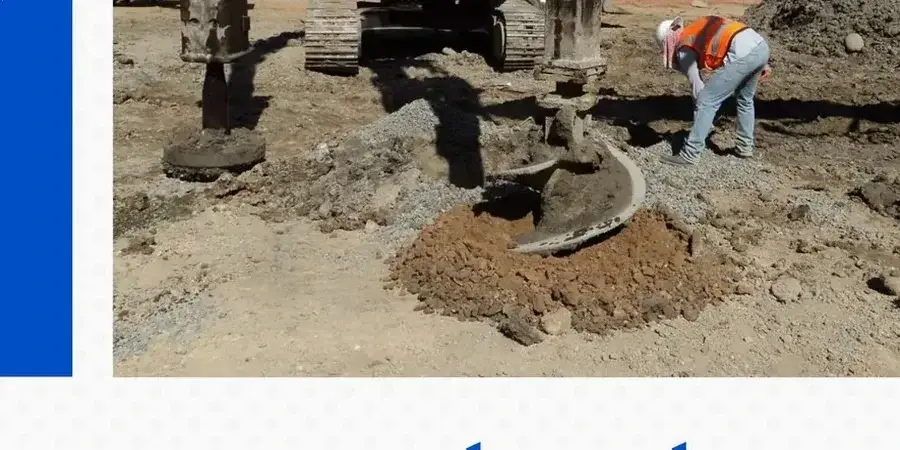
In New Zealand, ground improvement must comply with the Building Act 2004 and the New Zealand Building Code, particularly Clause B1 (Structure) which mandates resistance to loads including earthquake, wind, and snow. The Ministry of Business, Innovation and Employment (MBIE) Acceptable Solutions and Verification Methods, along with NZS 1170.5 for seismic actions and NZGS/MBIE Module 4 for liquefaction assessment, form the regulatory backbone. Engineers must also follow NZS 4402 for soil testing and the New Zealand Geotechnical Society guidelines, which outline best practice for design and verification of improvement works. These standards ensure that any ground treatment—whether by densification, drainage, or reinforcement—meets performance criteria validated through post-construction testing.
Typical projects requiring ground improvement in New Plymouth range from light industrial warehouses on the outskirts of Bell Block to multi-storey apartment blocks near the CBD, where weak near-surface soils cannot support shallow footings. Infrastructure such as bridge approaches, retaining walls, and tank farms also frequently demand soil treatment to control differential settlement and maintain serviceability. Vibrocompaction design is particularly effective for granular soils, using depth vibrators to densify loose sands and gravels, reducing void ratios and increasing stiffness. For finer-grained soils, stone columns offer a combined solution of reinforcement and drainage, accelerating consolidation and improving shear strength. Each project requires a tailored approach, balancing technical performance with environmental constraints and construction access.
Available services
Questions and answers
What is ground improvement and when is it needed in New Plymouth?
Ground improvement refers to the controlled modification of soil properties to increase bearing capacity, reduce settlement, or mitigate liquefaction. In New Plymouth, it becomes necessary when site investigations reveal weak volcanic ash layers, loose alluvial sands, or high groundwater that cannot support proposed loads under New Zealand Building Code Clause B1 without treatment.
How do local regulations influence ground improvement design?
Design must meet the performance requirements of the Building Code, supported by NZS 1170.5 for seismic loading and MBIE/NZGS liquefaction guidance. Verification methods typically require post-treatment testing such as CPT or SPT to confirm that acceptance criteria—often expressed as a target density or stiffness—have been achieved across the treated zone.
What are the most common ground improvement methods used in the Taranaki region?
Vibrocompaction is widely used for granular volcanic and coastal sands, densifying them with depth vibrators. Stone columns are common where finer silts need both reinforcement and drainage. Other methods include dynamic compaction for deeper deposits and rigid inclusions where settlement tolerances are tight beneath structural footings.
How long does ground improvement take and what disruptions can be expected?
Duration depends on method and site area—vibrocompaction may treat several hundred square metres per day, while stone column installation is slower. Vibration and noise are inherent but managed within council consent conditions. Most projects complete ground treatment within days to weeks, allowing foundation construction to follow immediately.
Location and service area
We serve projects across New Plymouth and surrounding areas.