New Plymouth sits at just 39 degrees south, but the real engineering story lies beneath its coastal terraces and the ring plain of Mount Taranaki. Much of the city, from the port area out toward Bell Block, is underlain by loose, water-lain pumice sands and volcanic ash beds that simply cannot support heavy structural loads without densification. When a recent warehouse extension near Centennial Drive encountered SPT blow counts below 6 in the upper four metres, the geotechnical brief was clear: deep vibrocompaction design was the only cost-effective path to adequate bearing capacity. Our laboratory team works directly with the vibroflot operator, feeding real-time grain-size distributions and fines content data into the design model, because in these volcanic-derived soils the percentage passing 75 microns dictates whether the ground will densify or simply vibrate. We often pair this with a CPT test program to map pre- and post-treatment tip resistance across the entire treatment grid, and in areas where the sand transitions into silty layers we evaluate whether stone columns would be a more reliable Improvement alternative.
In New Plymouth's volcanic sands, the difference between successful vibrocompaction and a failed treatment plan often comes down to a single parameter: the percentage passing 75 microns.
Approach and scope
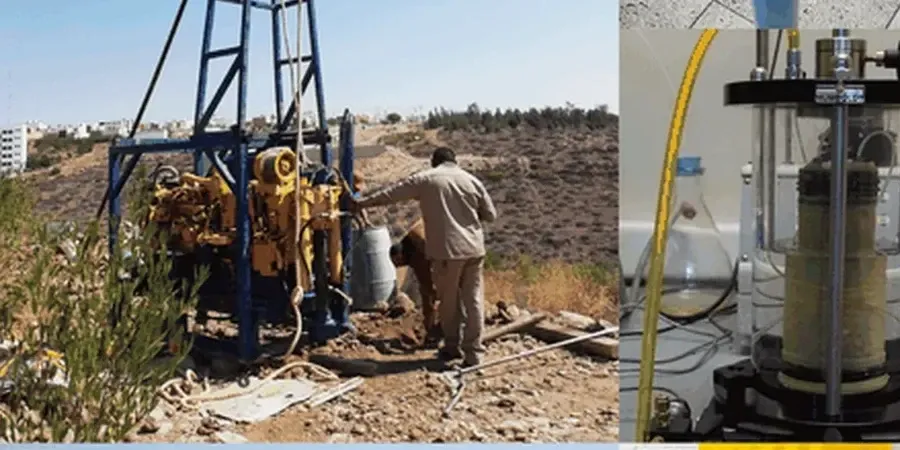
Local geotechnical context
The ground conditions beneath New Plymouth change dramatically within a few hundred metres. In the Fitzroy area, the soils are predominantly medium-dense coastal sands that respond beautifully to vibrocompaction, often reaching target density in a single pass. Drive south toward Westown or the hospital zone, however, and you encounter thicker interbedded silt layers within the sand sequence that can trap pore pressures, reduce the radius of influence of each vibro point, and create a serious risk of undertreatment if the design does not explicitly account for drainage paths. The biggest failure mode we see in the region is not equipment-related but design-related: applying a standard grid to a non-standard soil profile. When silt lenses are present, we modify the vibrocompaction sequence by introducing a rest period between phases to allow excess pore pressure dissipation, which we monitor with piezometers installed at mid-depth in the critical layer. Skipping this step has led to post-construction settlements of 40 to 60 millimetres in lightly loaded slabs, a problem that is entirely avoidable with proper laboratory characterization and a phased design approach.
Reference standards
NZS 3404:1997 Steel Structures Standard, NZS 4203:1992 General Structural Design and Design Loadings for Buildings, NZGS Guideline for Improvement (Module 4), NZS 4402/D4254 Maximum and Minimum Index Density, NZS 4402 Grain-Size Distribution (Sieve)
Related technical services
Pre-treatment Site Characterization
Full grain-size distribution, Atterberg limits, and maximum/minimum density testing on samples from each distinct soil layer to determine vibrocompaction feasibility.
Grid Design and Energy Calibration
Calculation of vibro point spacing, phase sequence, and vibrator energy input based on lab-derived uniformity coefficient and fines content, with NZS 3404 structural checks.
Post-compaction Verification
CPT soundings on a 5-metre grid before and after treatment, with cone resistance profiles compared to liquefaction resistance targets and bearing capacity requirements.
Pore Pressure Monitoring
Installation of vibrating-wire piezometers in silt-prone zones to track excess pore pressure dissipation between compaction phases and validate the rest period design.
Typical parameters
Questions and answers
What type of soil in New Plymouth is suitable for vibrocompaction?
The technique works best on clean to slightly silty sands with less than 15 percent passing the 75-micron sieve. Much of New Plymouth, especially the coastal strip and the areas around Bell Block, has loose pumice and greywacke sands that fall within this range. We always run a full grain-size distribution first because the volcanic ash layers can contain higher silt fractions than expected.
How much does a vibrocompaction design and verification package cost for a typical New Plymouth site?
For a standard residential or light commercial lot in the New Plymouth area, a complete package including laboratory characterization, grid design, and pre- and post-treatment CPT verification typically ranges from NZ$2.800 to NZ$7.470, depending on the treatment area and the number of verification soundings required.
How long does the entire vibrocompaction process take from design to verification?
Laboratory testing takes about five working days from sample delivery. The grid design can be completed within two days once we have the grain-size data. The field compaction itself depends on the area and depth, but a typical 400-square-metre site in New Plymouth can be treated in one to two days, with CPT verification performed the following week to allow for any excess pore pressure dissipation in silty zones.