New Plymouth’s subsurface is shaped by the ring plain of Taranaki Maunga, where sequences of lahar deposits, volcanic ash layers and alluvial sands interleave above the Papa mudstone formation. The water table sits high across much of the city — often within 1.5 to 3 metres of ground level in the coastal belt — and the region’s moderate seismicity, governed by NZS 1170.5, means that any excavation deeper than 4 metres must account for lateral earth pressures during a design-level earthquake.
Deep excavation design here revolves around three interlocking challenges: managing groundwater inflow without triggering internal erosion of fine volcanic silts, controlling wall deflections in the soft residual soils that mantle the city’s eastern suburbs, and ensuring basal heave does not compromise adjacent pile-supported structures. With the CBD renewal driving multi-level basements into the Ngatoro and Fitzroy areas, the MASW and seismic refraction surveys that feed shear-wave velocity profiles into Plaxis or Wallap models have become the starting point for most shoring designs in the district.
In New Plymouth, the real design driver is not the excavation depth but the pore pressure regime in the layered volcanic sequence — get the groundwater model wrong and the shoring loads double.
Approach and scope
The design workflow we follow integrates NZGS guideline modules on earth pressure distribution with site-specific parameters derived from borehole logging and laboratory index testing. Key elements include: selecting a drained or undrained strength envelope depending on the Papa’s OCR profile, modelling the effect of tidal fluctuation on pore pressures within the New Plymouth coastal aquifer, and specifying shotcrete facing thicknesses that can bridge the irregular surface left after trimming through mixed-face conditions. For temporary works with a stand-up time exceeding six months, we also factor in the gradual strength loss that remoulded volcanic ash exhibits under cyclic wetting and drying.
Local geotechnical context
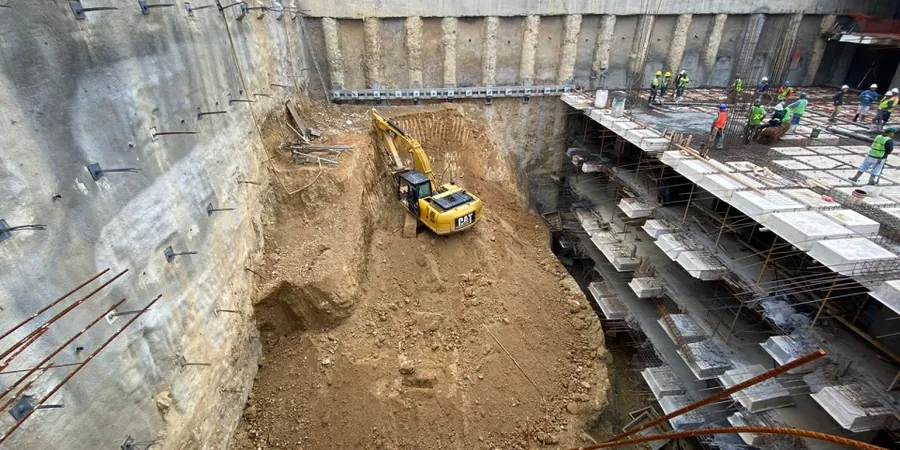
A 13-tonne excavator fitted with a rock breaker stands idle on the Port View Crescent jobsite while the ground beneath the adjacent two-storey warehouse settles by 11 millimetres overnight — the consequence of a buried paleochannel that the pre-construction boreholes missed.
New Plymouth’s coastal strip conceals old stream courses filled with loose pumiceous sand and organic silt that collapse under the drawdown gradient created by dewatering. The risks compound when a shoring design assumes homogeneous ground: a single ungrouted cobble lens can channel groundwater into the excavation face at 15 litres per second, eroding fines from behind the wall and creating voids that propagate toward the surface. The hazard becomes acute in winter, when the Taranaki rainfall exceeds 200 millimetres per month and the aquifer recharges faster than sump pumps can discharge. A solid observational method — with trigger levels tied to inclinometer rotation rates and piezometric head — is the only reliable defence against progressive collapse in these conditions.
Service video
Reference standards
NZS 3404.1:2009 – Steel structures (anchors, walers, soldier piles), NZS 1170.5:2004 – Seismic actions (earthquake load combinations for retaining), NZS 4203:1992 – General structural design (superseded but still referenced in older council asset records), NZGS Guideline for Earth Pressure on Retaining Walls (2020), Eurocode 7 – EN 1997-1:2004 (Geotechnical design, used as supplementary framework)
Related technical services
Shoring and retention system design
Analysis of soldier pile, secant pile and diaphragm wall configurations using Wallap and Plaxis 2D, incorporating the NZGS earth pressure guideline distributions for the layered volcanic profile typical of the Taranaki ring plain.
Groundwater control and dewatering plans
Design of deep well and ejector dewatering systems for excavations penetrating the New Plymouth coastal aquifer, including drawdown predictions, settlement assessment of adjacent structures, and discharge consent documentation.
Basal stability and heave assessment
Undrained and drained basal heave checks using modified Terzaghi factors for the Papa mudstone, coupled with finite element analysis of excavation-induced unloading and its effect on nearby pile foundations.
Typical parameters
Questions and answers
What depth of excavation typically triggers a full geotechnical design in New Plymouth?
Under the New Zealand Building Code (clause B1), any excavation deeper than 1.5 metres that could affect a neighbouring property requires a geotechnical assessment. In practice, for the volcanic soils found across New Plymouth, a formal shoring design is generally commissioned once the cut exceeds 3 to 4 metres. The shallow water table along the coastal belt often brings groundwater control into scope even for relatively modest basements.
How does the Papa mudstone affect deep excavation design?
The Papa is a heavily overconsolidated calcareous mudstone that behaves as a competent rock in the short term but can soften and swell when exposed to air and water. Our designs specify a minimum 50 mm shotcrete seal applied within 24 hours of exposure, and we use drained strength parameters for long-term wall design — typically a friction angle of 28 to 32 degrees with a low cohesion intercept after relaxation.
Does seismic loading control the shoring design in New Plymouth?
For most medium-rise basements, seismic earth pressures calculated under NZS 1170.5 add 15 to 25 percent to the static wall loads. The governing case is often the post-earthquake serviceability check: even if the wall does not collapse, excessive permanent displacement can damage operations entering the basement. We typically limit seismic displacements to 25 millimetres for structures on shallow foundations adjacent to the excavation.
What is the typical cost range for a deep excavation design in New Plymouth?
The fee for a complete geotechnical excavation design package — including shoring analysis, dewatering plan and construction monitoring specifications — ranges from NZ$3,520 for a straightforward single-level cut to NZ$12,930 for a multi-level basement with complex groundwater interactions and adjacent heritage structures. The final figure depends on the number of support levels, the extent of instrumentation specified, and whether peer review by an external checker is required.
How long does the design process take from investigation to issued-for-construction drawings?
A typical timeline for a New Plymouth project runs four to six weeks: one week for targeted borehole drilling and sampling through the volcanic sequence, two weeks for laboratory triaxial and oedometer testing on the Papa and lahar materials, and two to three weeks for numerical modelling, parameter back-analysis, and preparation of the producer statement (PS1) documentation for council.