The volcanic lahar deposits beneath New Plymouth can fool you. What looks like solid ground from the surface is often a layered mix of andesitic gravel and soft pumice silts, courtesy of Mount Taranaki's historic flows. Getting a reliable bearing capacity here means you can't rely on surface inspection alone. The Standard Penetration Test gives us a direct measurement of soil density and consistency at depth, providing the N-value data structural engineers need to size footings correctly. In a city where shallow groundwater is common across the coastal plain, we frequently pair SPT with in-situ permeability testing to understand how water movement might affect excavation stability and long-term foundation performance.
In New Plymouth's lahar terrain, a 15-metre SPT profile can reveal the difference between a straightforward shallow footing and an expensive deep-pile solution before the first shovel hits the ground.
Approach and scope
Local geotechnical context
NZS 3404 and the NZGS soil description guidelines set a clear expectation for site investigation in New Zealand. In New Plymouth specifically, the risk of encountering undocumented fill over buried peat or soft alluvium is real, especially within the old Fitzroy-to-CBD corridor where early settlement altered natural drainage patterns. Skipping a proper SPT investigation in these areas can lead to differential settlement that cracks slabs and operations within a few years of construction. The cost of remediation after the fact dwarfs the investment in a targeted drilling programme. For larger commercial builds, the seismic provisions of NZS 4203 also require reliable N-values to assess potential liquefaction in saturated sandy layers, something we've identified at several sites along the coastal strip. The data from a well-executed SPT programme gives council consenting officers the confidence to sign off on your foundation design without delays.
Reference standards
NZS 4402, NZS 3404, NZS 4203, NZGS Guideline for Field Description of Soils
Related technical services
Residential SPT Investigation
Two to three boreholes to 10–15 metres, providing bearing capacity data and liquefaction screening for single-dwelling or small subdivision consent applications. Includes NZGS-compliant soil logging and N60 reporting.
Commercial and Industrial SPT
Multi-borehole programmes with deeper targets (20–30 metres) for warehouse, retail, and multi-storey structures. We manage traffic control, service clearance, and deliver a full interpretive report ready for your structural engineer.
Combined SPT and Laboratory Package
SPT fieldwork paired with laboratory testing on recovered samples: grain size analysis, Atterberg limits, and consolidation testing. Ideal when the ground profile includes plastic silts or organic layers that need classification beyond field logging.
Typical parameters
Questions and answers
How much does SPT testing cost for a standard residential site in New Plymouth?
For a typical residential investigation with two boreholes to 10–15 metres depth, budget between NZ$900 and NZ$1,400 plus GST. The final figure depends on access conditions, traffic management requirements if drilling on the street verge, and whether you need a full interpretive report or just raw field data. We carry out a fixed quote after reviewing your site location and project plans, so there are no surprises.
How deep do you typically drill for SPT in New Plymouth?
Most residential investigations go to 10–15 metres, which gets us through the lahar deposits and into the underlying residual soils or bedrock. For commercial projects in the CBD or near the port, we often extend to 20–30 metres to capture deeper soft layers and assess liquefaction potential under seismic loading. The exact depth is tailored to your structural loads and the specific geology at your site.
What do the N-values from an SPT actually tell my engineer?
The N-value is the number of hammer blows to drive the split-spoon sampler the last 300 mm of a 450 mm penetration. It correlates directly with soil density in sands and consistency in clays. Your structural engineer uses the N-values to calculate allowable bearing capacity, estimate footing settlement, and assess liquefaction susceptibility. We carry out both raw N-values and N60 energy-corrected values so the data is directly usable in design software and hand calculations.
How long does SPT drilling take and will it mess up my site?
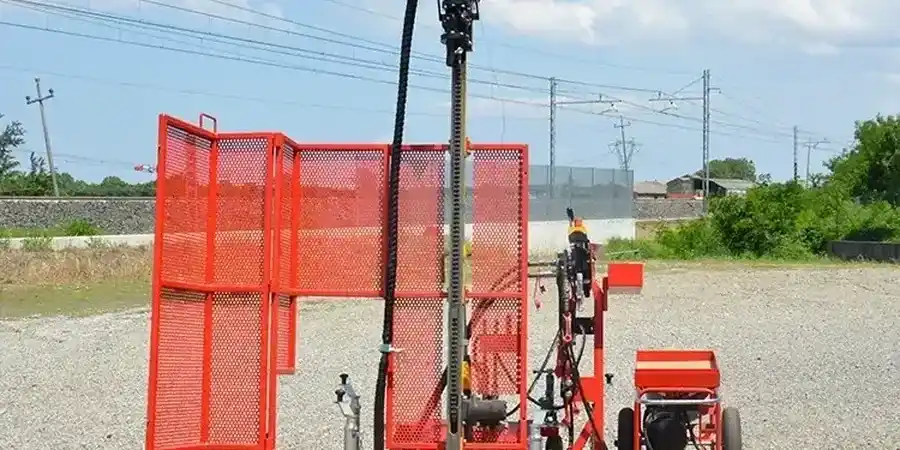
A two-borehole residential programme usually takes one full day on site. We use truck-mounted or track-mounted rigs depending on access, and the boreholes are backfilled with cement grout or bentonite chips after logging. The surface disturbance is minimal: each borehole leaves a patch about 300 mm across, easily tidied up before we leave. For sites with tight access, we can use a portable rig that fits through a standard gate.